


The first thing Faith Welch ever said wasn’t “mamma” or “dad.”
It was a question.
“Her first word — and it wasn’t just one word, it was a phrase — was ‘What’s that?'” her mother, Alyssa Welch, recalled with a laugh. “She said it all the time. She was always curious, always interested in lots of different things.”
When Faith was a little girl, her father Alfred Welch would hand her books to read to him aloud during the family’s morning drive. She was reciting the Bible at the age of four. The Welch family had one car then. Faith’s mother would drive her husband to work before school, and he used the time to cultivate something in their oldest child that would eventually shape much of her life.
“My husband wanted her to love reading, wanted her to enjoy it,” Alyssa recalled in an interview. “As we were driving, he’d be like, ‘Babe, can you read?’ And she would read.”
Years later, when she was a teenager, Faith’s father would drive his daughter west again, this time from Greenport into Harlem. They’d set out early every Saturday morning, so she could study on high school weekends at the Schomburg Center for Research in Black Culture.

By then, reading was no longer something her father had to encourage. Faith had begun searching for answers herself. She graduated from Greenport High School this year after serving as student council president, founding and serving as president of the school’s first African American Studies Club, leading the school’s a cappella group, performing in musicals and, last year, becoming the Greenport School Board’s first student ex-officio board member.
Outside school, she became a youth ambassador for Coming to the Table North Fork, studied as a Schomburg Junior Scholar, researched slavery and Black history on the North Fork and helped organize local Juneteenth celebrations. Her work earned her the Princeton Prize in Race Relations, recognition as The Suffolk Times’ 2025 Community Leader of the Year and, this spring, a place among Newsday’s 2026 Extraordinary Seniors.
This month, she left Greenport for New York City, to attend Barnard College. The list of her accomplishments, though, obscures something even more interesting about this ambitious 18-year-old: None of this was mapped out for her.
‘Brilliant and brave’
Her parents emphasized education, discipline and Christianity, but Faith said African American history was not a central subject in their home. Her father is Black and her mother is white, and Faith said her growing interest in race sometimes led her into territory her parents may not have actively explored themselves. Her father once told her that racial slurs he encountered growing up didn’t affect him the same way he could see they affected his daughter.
“He was like, ‘Yeah, I grew up being called the N-word and stuff like that … but it never really hit me the way it hits you,'” Faith said. “I guess in their culture, in that time, it was a little more normalized. But for me personally, I just couldn’t agree with that.”
The difference between generations became part of her education. So did being biracial. As she grew up, Faith sought out Black women she could talk to about experiences that her mother could love and support her through, but did not personally share. Among them were Pastor Natalie Wimberly of Greenport’s Clinton Memorial A.M.E. Zion Church and her cousin, Greenport Village Clerk Candace Hall. Southold Town Councilman Brian Mealy has also been a good friend and mentor.

Hall has known Faith since she was born. What she watched happen during Faith’s adolescence was the development of an exceptional student, for sure, but also a young woman becoming increasingly comfortable with shaping her own identity.
As a young teen, Faith had worn her hair straight and, for a time, dyed it blonde. Hall saw something significant happening when her younger cousin began embracing her natural hair and simultaneously immersing herself in Black history and culture.
“She’s brilliant, and she’s brave,” Hall said. “It’s such a beautiful awakening to see a Black girl come into her own and know that, ‘if I want to wear my hair straight, it’s because I want to wear my hair straight. It’s not because I want to be accepted.’”
Faith’s awakening coincided with a larger one across the nation. She was 12 when the murder of George Floyd prompted another national reckoning over race and policing. She saw Harriet, about Harriet Tubman, and later watched Ava DuVernay’s When They See Us, a 2019 dramatization of the prosecutions and the wrongful convictions of five Black and Latino teenagers in the Central Park jogger case.
That one stayed with her.

“Seeing how just being a minority and just being at the wrong place at the wrong time can change your whole life — it made me really angry and really frustrated,” Faith said. “It made me realize that even if I can’t change the whole world and how people think, if I could be a lawyer and have that position to make any type of change for the people that go through this, then that’s what I’d want to do.”
At that point, her research moved much closer to home. Faith began studying slavery on the North Fork and came to believe that the history embedded in familiar places and prominent local family names was far more complicated than she had initially understood. The work altered her understanding of the community itself.
“A lot of people try to act like slavery just happened in the South, but it didn’t,” Faith said in an interview last month in Mitchell Park. “It literally happened here — in this village, in this town.”


‘A big deal’
Hall understood why that work mattered. She had spent part of her own youth in Northern Virginia, where her predominantly white high school also supported organizations specifically devoted to Black, Asian and other cultures. She belonged to a club for Black girls where members studied together, supported one another and visited historically Black colleges. Returning to the North Fork as an adult felt different.
“In New York, it’s like a mixing pot, but nobody’s really paying attention to the ingredients,” Hall said. “In other places, the ingredients are celebrated.”
Hall said that experience gave her a particular appreciation for what her cousin was attempting.
“Watching my little cousin choosing to go against everything, even our own community — they’re not used to that here,” Hall said. “Faith doing this work is a big deal. Aside from how smart she is, how vocally talented she is … this girl chose to go to Schomburg and get that experience, and that just flooded her interest.”
Faith also began bringing other young people with her. Mealy saw that firsthand when she appeared before an Eastern Suffolk BOCES committee normally populated by adults and elected officials.
Faith didn’t just show up. She drew an audience.
“She brought the most people,” the town councilman recalled. “There were educators there, her parents, people from Eastern Suffolk BOCES – all these people came to that meeting.”
‘Her first word — and it wasn’t just one word, it was a phrase — was ‘What’s that?’ She said it all the time. She was always curious, always interested in lots of different things.’
Alyssa Welch
On another occasion, he said, she persuaded 15 or 20 young people to attend a meeting.
“I don’t think if you had paid the kids and had a free lunch of pizza, could you have gotten them,” Mealy said. “But Faith Welch was able to get the kids to come.”
Amy Priesling was one of the young people drawn into Faith’s orbit. The two became close over the past year and a half, with Priesling serving as vice president of the African American Studies Club.
“We can talk about politics, we can talk about social issues in the world, but we can also talk about beauty. We can talk about friends. We can talk about normal teenage girl things,” Priesling said. “But then we can also connect on a deeper level. It’s really hard to find somebody to have those types of conversations with.”

Priesling will help take over the club this fall and plans to become more involved with Coming to the Table and Juneteenth. Continuity matters. Priesling said getting teenagers to engage publicly on issues of race and politics on the North Fork isn’t easy.
“It’s hard for a lot of teens to talk about politics, talk about the social issues that are happening around us,” she said. “With things like the African American Studies Club, it’s kind of hard to get members because people are kind of afraid to be that outspoken.”
‘This is not right’
In June 2025, some of the issues Faith had been studying and talking about got real personal, real fast, with no warning.
She and a friend were waiting outside the King Kullen in Cutchogue for an Uber to head to the Mattituck Lions Club Strawberry Festival when someone reported them to police as suspected car thieves, “going through the parking lot … looking through car windows and checking door handles.” Police responded and stopped their Uber.
At first, Faith assumed the police were after the driver. Instead, officers questioned them.
“They told us that we were stealing cars,” she recalled. “We’re like, ‘Where are the cars? What are you talking about?'”

Officers questioned them, ran their identification, realized it was a false report and apologized.
“The worst part about it is that it’s out of your control — that feeling that you can’t control how people think about you,” Faith said. “For a lot of minorities, that’s just reality. People have their stereotypes automatically, and you can’t change how people feel about you.”
Hall learned what happened within an hour. She was furious. Faith responded in her own way.
“Our attention shifted to, ‘What’s Faith doing?'” Hall recalled. “Immediately, she shifted into, ‘This is not right.’ She was immediately articulate and expressing what happened to her … using her story not to shame anybody, but to bring awareness.”
In an interview, Hall was emphatic, saying that the episode stripped away any notion she had that education, accomplishment or community standing provides insulation from prejudice.
“In our beautiful little North Fork, this beautiful girl that you all freaking know and see in the newspaper all the time — yup, it even happens to her.”
Faith spoke about the experience last summer at a joint meeting of the Greenport Village Board and the Southold Town Board. Mealy was there, listening as both an elected official and a Black man who had experienced some of the same things.
“I just let her know she wasn’t alone,” he said. “That was a proud moment for me, just to say, ‘I got you. I understand.'”
Then he flipped the script.
“We think as adults we can encourage her,” Mealy said. “She’s encouraged us to do right.”


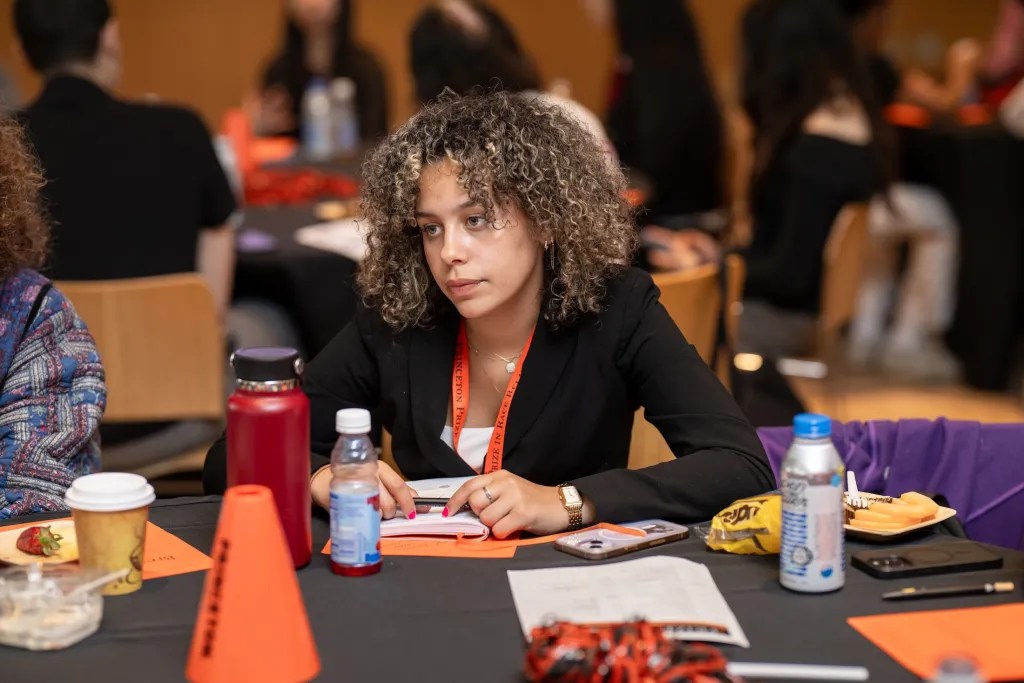


‘99% of myself’
The encounter also exposed something beneath the surface for Faith. She describes herself as someone who can become consumed by what she cares about, sometimes to her own detriment. The police encounter briefly made her question whether the work was worth it, she said.
“When I care about something, I put a lot of myself into it, like almost 99% of myself. When you put your all into something, it’s easier for it to hurt you.”
Her mother sees the same intensity.
“If she says she’s going to do something, she’s going to do it,” Alyssa said. “If she says she’s going to be somewhere, unless something happens where she absolutely cannot get there, she’s going to be there. She will go and support the things that she believes in.”
‘It’s such a beautiful awakening to see a Black girl come into her own…’
Candace Hall
Now Faith is headed off to Barnard, which will place her in a much broader world. Hall believes her cousin needs that distance to move into the next stage of an education that began here on the North Fork.
“Faith has already invested so much of her free time into our community,” Hall said. “She deserves this time away from home.”
Hall’s pride in her cousin rings out, even over the phone.
“Those gems that she’s going to catch while she’s in the city and around truly diverse people … are going to encourage her to continue this work, and I think she needs that so that our community can reap the benefit of what she’s going to do.
“Faith is going to always be a waymaker for other people.”


For Alyssa, the impending departure is less abstract.
“I had her very young, so I’ve grown up with her, and she’s grown up with me,” she said. “It’s going to be a huge adjustment for our household, because we have four kids and they’re all very close. It’s going to be hard.”
She described fears every parent confronts when a child leaves home for the first time.
“But I believe in her and her judgment.”
Faith doesn’t know whether she will ultimately return to live on the North Fork. She talks about becoming an attorney, working in New York City or Washington and continuing the work that has already begun to define her young life.
But asked to imagine herself 20 years from now, she talked about Greenport.
“I wouldn’t really feel that I had fulfilled what I wanted to do until I come back here and see that things have changed,” Faith said. “I’d love to see kids following in my footsteps.”
At least one of them already is.
“Amy,” Faith said of the friend inheriting the club she founded. “When I hear the way she talks about things, I’m like, ‘yes — these are the people we need out here.’”



What an awesome article, what an awesome young lady. Faith your community is so proud of you and the women you are becoming. Congratulations continue to spread your wings at Barnard.
I am so proud to see all the accomplishments and lovingkindness that Faith exudes since a babe. She was as amazing then as she is now.
I vividly remember that incident and my combination of outrage and pride. Forgot Faith’s name, but never will again.